Why Paris Is Called the "Belly of Paris": Zola, Les Halles & Rue Montorgueil
Paris is called "the belly of Paris" because the novelist Émile Zola gave that nickname to Les Halles — the great central market that fed the city for centuries — in his 1873 novel Le Ventre de Paris, which is French for "The Belly of Paris." The name attached itself to the market district, and to the market street beside it, Rue Montorgueil.
What "le ventre de Paris" means
Le ventre de Paris translates literally as "the belly of Paris." The word ventre is the ordinary French word for the stomach or abdomen — the part of the body that takes in food and turns it into the energy a city runs on. As a nickname it is not about a monument or a quarter being pretty or grand; it is about a function. Les Halles was the place where Paris was fed: where produce, meat, fish and flowers arrived by night, were divided up, and were sent back out across the capital by morning.
The phrase is a literary nickname, not a medieval one. The market "was known as the 'Belly of Paris', as Émile Zola called it in his 1873 novel Le Ventre de Paris." The title came first, on the cover of the book; the city adopted it afterwards.
Zola's novel and the market it described
Le Ventre de Paris was published in 1873. It is the third novel in Émile Zola's twenty-volume series Les Rougon-Macquart, and Zola's first written entirely about the working class. The full French text is in the public domain and is available free from Project Gutenberg.
The story is set in and around Les Halles, the enormous central market of 19th-century Paris, rebuilt in cast iron and glass under the Second Empire. Its protagonist, Florent, is an escaped political prisoner who was mistakenly arrested after the coup of 1851. He returns to his half-brother Quenu and Quenu's wife Lisa, finds refuge with them, and takes a job in the market as a fish inspector — an appointment that puts him inside the same halls the book is named for. Drawn into a harmless socialist plot against the Empire, Florent is arrested and deported a second time.
Zola's aim was to make the market itself the subject: its night-time labour, its traders, and above all its sensory overload. The book's best-known passage describes the smell of a cheese shop in orchestral terms — a set piece later readers nicknamed "the Cheese Symphony." An early English translation, by Henry Vizetelly, appeared in 1888 under the title Fat and Thin.
The market that earned the name
Les Halles was Paris's central market long before Zola wrote about it. The Archives de Paris, in its teaching resource on the district, treats Les Halles as an economic space running from 1135 to 1974 — a market ordered and reorganised by public authority, century after century, to feed the capital and its region.
Its most famous form is the one Zola knew. In the 1850s, in the middle of Haussmann's rebuilding of Paris, the architect Victor Baltard designed the glass-and-iron pavilions that would house the market for more than a century. Their light, industrial structure became one of the sights of Paris, and by Zola's time the place had become entirely a food market — exactly the "belly" his novel describes.
The market's life in the centre of Paris ended in two stages. The wholesale trade was moved out to the new market at Rungis, in the suburbs: the fruit, flower and vegetable markets left in 1969, and the remaining meat market traded until 12 January 1973, the market's last operating day. The iron pavilions were pulled down in the 1970s, and the area became simply "the Halles district."
What stands on the site today
Where the pavilions stood there is now an underground shopping centre, the Forum des Halles, which opened in 1979 and was rebuilt and reopened as the Westfield Forum des Halles. It is topped by the Canopée, a vast undulating canopy of glass and metal that was inaugurated, together with the redesigned Forum, on 5 April. The whole complex is welded to the Châtelet–Les Halles transit station — the first entry point of the capital by public transport, with 750,000 passengers transiting daily.
Where the market halls were, there is also a garden. The Jardin Nelson Mandela covers 4.3 hectares and holds 513 trees. Its children's play area is designed for ages 7 to 11, with a separate, smaller area for ages 2 to 6. The garden's address is 32 rue Berger, Paris 1er; the adventure playground's entrance is at the foot of the Bourse de Commerce, and access has been improved for visitors with reduced mobility.
The Westfield Forum des Halles has around 168 shops across 60,000 m², around 2,100 parking spaces and some 50 million visitors a year — the busiest shopping centre in France as of 2019. Around the garden stand two older neighbours: the church of Saint-Eustache, built in the 16th century, and the Bourse de Commerce, which began life as the circular Halle aux Blés (corn exchange) of 1763–69 before being converted into the stock exchange building in 1889.
Rue Montorgueil: the market street that kept the name
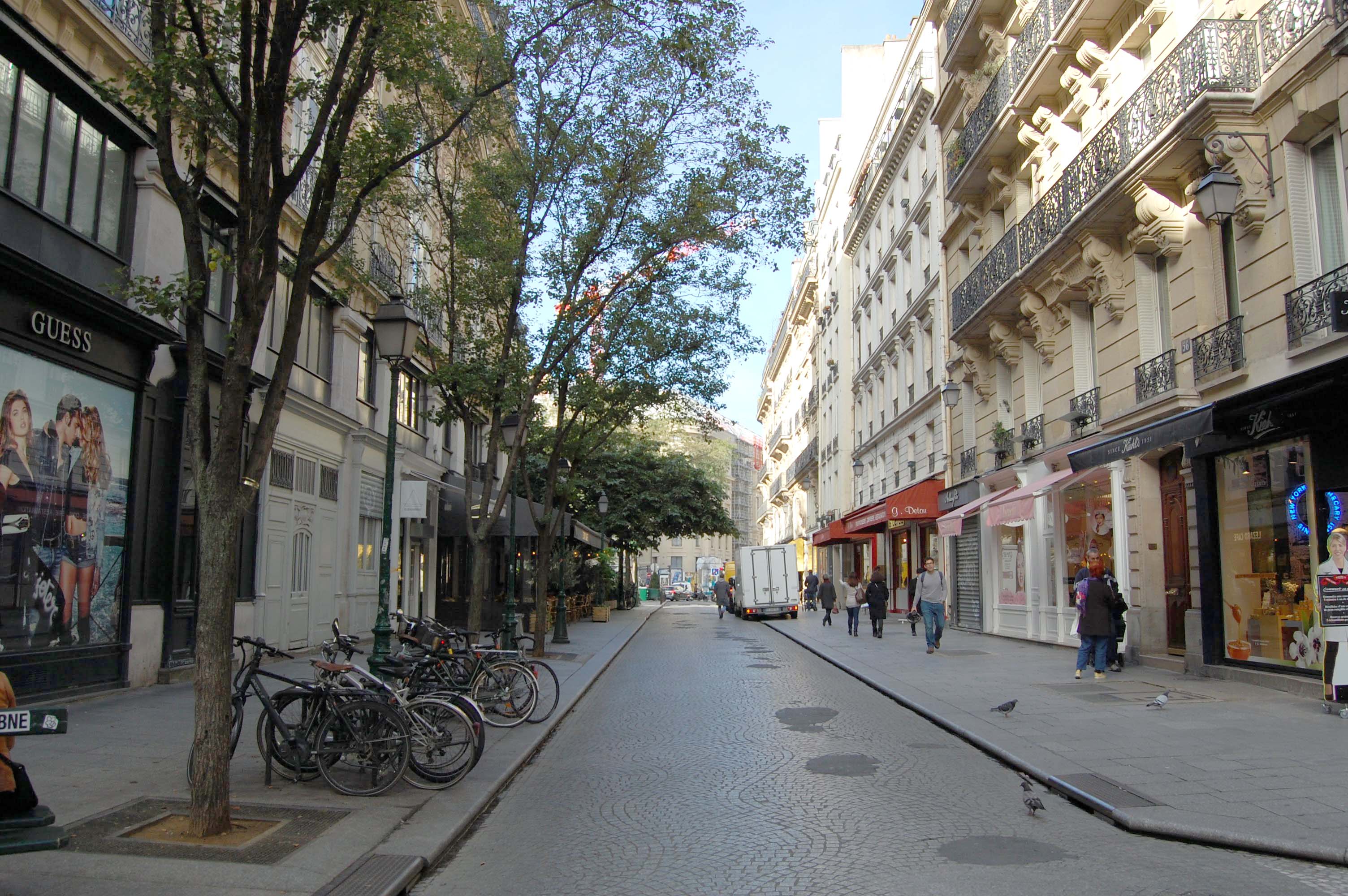
Rue Montorgueil runs just north of Saint-Eustache and Les Halles, between the 1st and 2nd arrondissements. When the great market was dismantled, its produce trade did not vanish from the neighbourhood; it flowed onto this street, and Rue Montorgueil became the daily food-shopping street for the residents left behind — the pedestrian corridor of butchers, fishmongers, bakers and cafés that visitors walk today. The street has carried the market's nickname ever since: on Rue Montorgueil, "the belly of Paris" is not a piece of history but an address.
The street's own timeline is worth reading on our Rue Montorgueil history page, which runs from the royal market of the 12th century to the present. Two long-standing addresses keep the market's tradition alive in the same blocks: Stohrer, the pastry shop at 51 rue Montorgueil, a Paris pâtisserie "since 1730"; and L'Escargot Montorgueil at no. 38, the snail restaurant that belongs to the same cluster of historic food businesses.
To walk the connection yourself, follow our guide to walking from Rue Montorgueil to Les Halles. For the wider neighbourhood, see the guide to the 2nd arrondissement and the sightseeing overview. If you are here to eat your way along the street, the self-guided food tour and the dining guide pick up where this page leaves off.
Timeline: from market to nickname and back
| Year | What happened |
|---|---|
| 1135 | The Archives de Paris dates the Les Halles economic space from this year; the market is reorganised by public authority over the following centuries. |
| 1183 | King Philip Augustus formalises the central market at Les Halles, anchoring Paris's food trade in this district. |
| 1850s | Victor Baltard's glass-and-iron pavilions are built to house the market; they stand for over a century. |
| 1873 | Émile Zola publishes Le Ventre de Paris ("The Belly of Paris"), the source of the nickname. |
| 1969 | The wholesale market moves out to Rungis; the fruit, flower and vegetable markets leave Les Halles. |
| 12 January 1973 | The last operating day of the Les Halles market; the remaining pavilions are demolished in the 1970s. |
| 1979 | The Forum des Halles, an underground shopping centre, opens on the site. |
| 5 April 2016 | The Canopée and the redesigned Forum des Halles are inaugurated. |
Frequently asked questions
Why is Paris called the belly of Paris?
Because Les Halles, the city's central market, was where Paris was fed — and the novelist Émile Zola gave the market that nickname in his 1873 novel Le Ventre de Paris, "The Belly of Paris." The name passed from the book to the market district and to the streets around it.
Who called Paris the belly of Paris?
Émile Zola. The phrase comes from the title of his 1873 novel Le Ventre de Paris, the third book in his Les Rougon-Macquart series.
What is Le Ventre de Paris about?
It is set in and around the Les Halles market of 19th-century Paris. Its hero, Florent, an escaped political prisoner, returns to the city, finds work in the market as a fish inspector, becomes entangled in a socialist plot, and is arrested and deported again. It was Zola's first novel written entirely about the working class.
What happened to the Les Halles market?
The wholesale trade moved out of central Paris to Rungis in 1969, and the market's last trading day was 12 January 1973. Baltard's iron pavilions were demolished in the 1970s and replaced by the underground Forum des Halles (opened 1979), later rebuilt with the Canopée canopy, inaugurated on 5 April 2016. The name lives on in the district — and on Rue Montorgueil next door.
Sources and notes. Official sources: Ville de Paris (paris.fr) for the Canopée inauguration on 5 April, the 750,000 daily passengers at Les Halles, and the Jardin Nelson Mandela figures (4.3 hectares, 513 trees, play areas for ages 7–11 and 2–6, entrance at the foot of the Bourse de Commerce, improved accessibility); the Archives de Paris for the history of Les Halles as an economic space, 1135–1974, and for the move of the wholesale market to Rungis; Stohrer (stohrer.fr) for the 1730 founding date; Project Gutenberg for the public-domain text of Le Ventre de Paris. Figures and dates marked as secondary — Philip Augustus's 1183 market, Baltard's pavilions, the market's 12 January 1973 last day, the 1979 Forum opening and its visitor numbers, and the Halle aux Blés / Bourse de Commerce dates — come from the Wikipedia articles Les Halles, Le Ventre de Paris and Rue Montorgueil and are included only where no official source states them.