Rue Montorgueil with Kids: A Family Guide to Paris’s Market Street
👨👩👧 At a glance
Street length: under 500 m | Ground: flat, cobbled, pedestrian-priority | Nearest playground: Jardin Nelson Mandela, 32 rue Berger, Paris 1e | Nearest station: Châtelet–Les Halles (Lines 1, 4, 7, 11, 14 + RER A, B, D)
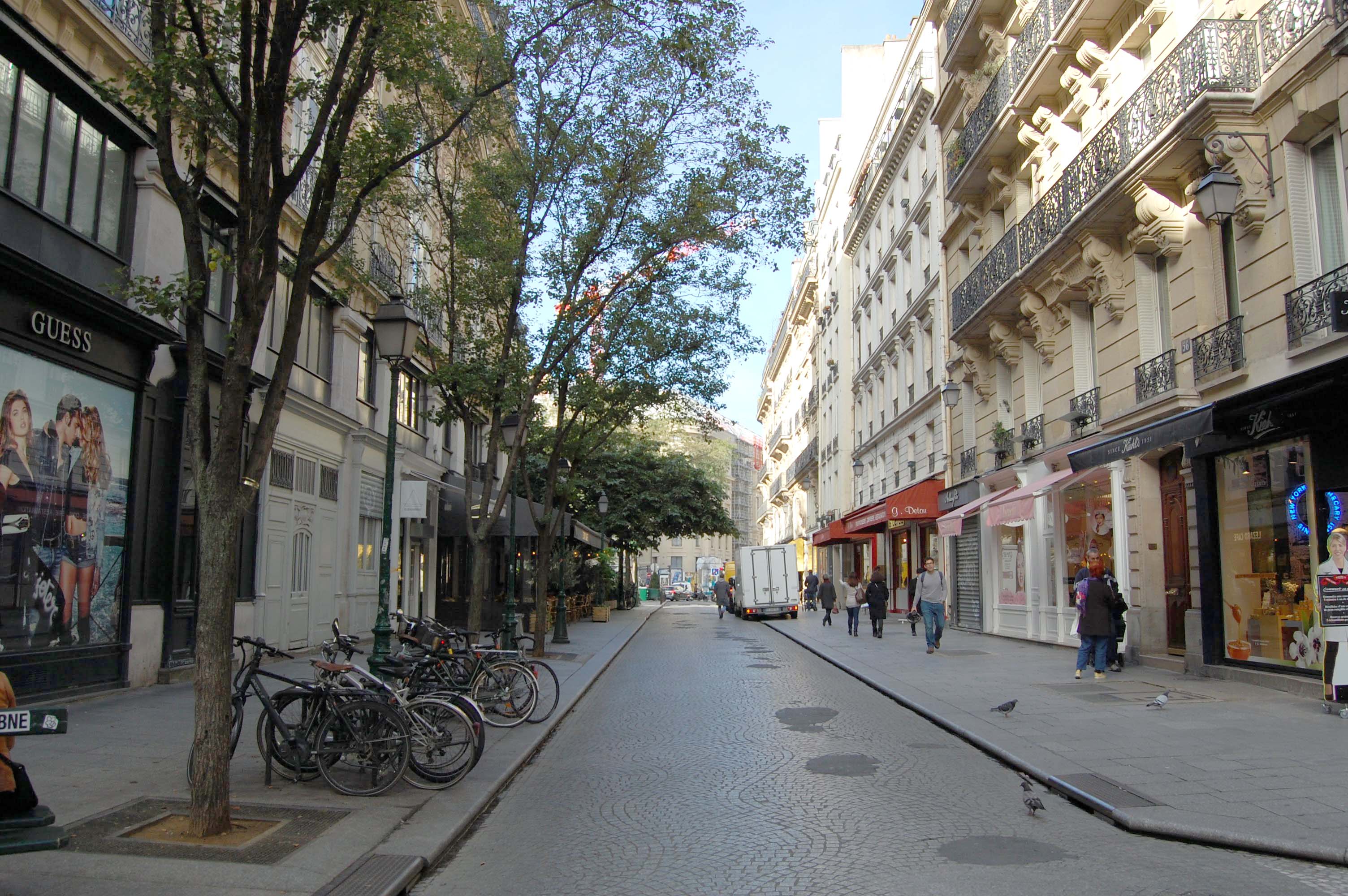
Rue Montorgueil is short, flat and pedestrian-priority — three things that matter far more than any sight when you are out with children. It is a working market street rather than a monument, so a visit does not need a plan: you walk it, you buy something to eat, and you let the children run at the end of it.
The street runs from Les Halles and the church of Saint-Eustache at its southern end up towards the Grands Boulevards, lined with bakeries, cheese shops, fishmongers, wine shops, greengrocers and cafés. Because the whole street is under 500 metres long, you can walk it properly in under half an hour — or stretch it into a morning with a food stop and a play stop.
This guide covers the practical questions parents actually ask: when to come, what children will eat, where they can run off the sugar, and how to arrive with a buggy. Everything below is tied to an official or named source; where a detail is uncertain, the guide says so rather than guessing.
Why Rue Montorgueil works with children
It is short. At under 500 metres, the street never becomes a forced march. There is no long walk in, no long walk out, and no need to commit a whole day to it.
It is flat and pedestrian-priority. Cars are not banned from Rue Montorgueil, but the priority on the street is given to pedestrians, who share the cobbled surface with the shops and cafés. In practice that means children can walk beside you rather than being kept on a lead between kerbs.
It reads as a real neighbourhood. This is a street where Parisians do their daily shopping, which gives children something concrete to watch: displays being built, bread coming out, fish set on ice. It is a better introduction to Paris for a restless child than a silent museum room.
Two honest caveats. The cobbles are uneven, so a small-wheeled stroller will rattle and a scooter will struggle; a stroller with larger wheels copes far better. And many of the shops are genuinely small, with narrow doors and a few steps — you will often be browsing from the doorway with the buggy parked outside rather than pushing it inside.
💡 Family tip
Treat the street as two stops, not one outing: a 20–30 minute walk-and-snack on Rue Montorgueil, then the garden at Les Halles a few minutes south, where the children can actually run. The combination fills a morning comfortably.
Best time to go with kids
Weekdays over Saturday. Weekdays are noticeably less crowded than Saturdays, which is the single biggest factor in whether a buggy can move along the street at all. Mornings carry the market energy: deliveries arriving, shops being set up, locals doing their shopping.
Plan around the closures. Many of the street’s traditional shops close on Sundays and Mondays, and a large number shut for lunch around 13:00–14:00. If you arrive at 13:30 on a Monday expecting a full market street, you will find shutters instead. Our market hours and shopping times guide sets out the day-by-day pattern in full.
Choose the season, not just the day. Spring and early autumn give the most comfortable walking weather for children; high summer afternoons are hot on exposed cobbles, and winter is best handled as a short loop with a café stop. The seasonal visiting guide covers month-by-month conditions.
What children can eat on the street
The street’s food is its point, and the easiest things to feed a child here are bakery food, eaten standing up or on a bench.
Stohrer, 51 rue Montorgueil. Founded in 1730 by Nicolas Stohrer, pastry chef to King Louis XV, this is the oldest pâtisserie in Paris and a listed historic site; the rum baba was invented here, and the Dolfi family has run the house since 2017. For a family visit the value is simple: pastries and viennoiseries that a child will actually finish, from a shop with real history attached. Expect a queue at peak times in a very small interior.
Bakeries, cafés and bistros. Beyond Stohrer, the street and its side streets are thick with bakeries, cafés and bistros, and this is where most families eat — a croissant, a sandwich, a citron pressé at a terrace table. Our restaurant and dining guide and the dining section list the named options.
L’Escargot Montorgueil, 38 rue Montorgueil. Open daily 12:00–23:00, this is the street’s famous snail restaurant — a novelty stop rather than a safe bet for a fussy eater. (We deliberately do not give the restaurant’s founding year here: the operator’s own site and other sources disagree, and an unresolved date is worse than no date.)
⚠️ What this guide will not tell you
We do not list children’s menus, prices, or which specific shops offer high chairs, because those details change constantly and cannot be verified from an official source. Ask at the table, or treat any such list you find elsewhere as unverified.
Where children can run: Jardin Nelson Mandela at Les Halles
The best thing you can do for children on a Rue Montorgueil visit is not on the street at all. Walk to the southern end at Les Halles and you reach the Jardin Nelson Mandela, the official Ville de Paris garden that replaced the old garden of Les Halles as part of the district’s renewal — a project designed by the Seura agency and retained by the City of Paris in 2004. It links the Canopée to the Bourse de Commerce and is fully open to the public.
Its address is 32, rue Berger, Paris 1e. The garden covers about 4 hectares and is laid out as an open, level space around a large lawn, with the church of Saint-Eustache at one end and the Canopée at the other. For a family, the important part is the play provision, which the City describes in detail:
| Play space | Ages | Size | Notes |
|---|---|---|---|
| Terrain d’aventures | 7–11 years | 2,500 m² | Unusual, climbable play equipment devised by the team of sculptor Henri Marquet; open 7 days a week |
| Children’s play area | 2–6 years | 1,400 m² | Separate younger-children’s area within the garden |
| Water play (jeux d’eau) | All ages | Along the Canopée side | Cooling water feature for hot days |
Open every day. The garden is listed as open 24 hours a day, seven days a week, so the Terrain d’aventures is described by the City as a play space open 7 days a week for children aged 7 to 11 — a genuinely unusual thing to find in the middle of Paris.
Facilities worth knowing. The garden has toilets, free WiFi and drinking-water points, and dogs are allowed on the paths (kept on a lead). One honest gap for families with babies: the City’s own listing states there is no baby-changing table, and no drinks dispenser, so plan accordingly.
Accessibility. The main entrance on rue Berger has some steps, so anyone using a wheelchair or pushing a heavy buggy is advised to use the other entrance on rue Sauval, on the Bourse de Commerce side. The rest of the garden is level and accessible, and the garden’s own play equipment is described as accessible too. Our Les Halles connection guide covers the walk between the street and the garden.
Getting there with a stroller or buggy
Rue Montorgueil sits between three stations, which gives you a choice depending on which end of the street you want.
| Station | Lines | Best for |
|---|---|---|
| Châtelet–Les Halles | Métro 1, 4, 7, 11, 14 + RER A, B, D | The southern end of the street and the Jardin Nelson Mandela |
| Étienne Marcel | Métro 4 | The middle of the street (Station is under rue de Turbigo) |
| Sentier | Métro 3 | The northern end of the street (97 rue Réaumur / rue des Petits Carreaux) |
One thing to expect: Châtelet–Les Halles is enormous. It is the largest underground station in the world and a three-station complex, with platforms separated by up to 800 metres and long walks between lines. Going in with a buggy is fine, but allow extra time and expect stairs and escalators rather than a single short platform. Métro Line 1 and Line 14 are the step-free options in the complex; on the RER, step-free access is available on RER A and B on request to staff, but not on RER D.
Full route detail, including coming in from the airports, is in how to get to Rue Montorgueil and the dedicated transportation and metro guide.
Practical tips for a family visit
Keep it short. The street rewards a 20–30 minute pass, not a two-hour tour. Pair it with the garden and you have a comfortable half-day.
Come in the morning, buy food, then move on. Shops are stocked and open, deliveries provide the entertainment, and you finish the walk at Les Halles just as the children need space to run.
Rest in the garden, not a café. Toilets, water and a lawn are free at the Jardin Nelson Mandela; a café stop costs money and asks a small child to sit still for longer than they will.
Where to stay. If you want the street as your base, the staying-here guide has a family-friendly accommodation section covering apartments and hotels with family rooms and kitchen facilities.
Frequently asked questions
Is Rue Montorgueil stroller-friendly?
Mostly. The street is flat and gives priority to pedestrians, but the surface is cobbled and many shops have narrow doors or a step, so you will often park the buggy outside. Larger wheels make a real difference; Châtelet–Les Halles, while step-free on Lines 1 and 14, involves long underground walks.
Is Rue Montorgueil worth visiting with children?
Yes, as a short food-focused walk rather than a day out. Under 500 metres of flat, pedestrian-priority street, real shops to look into, and an official play garden a few minutes away at Les Halles make it an easy, low-risk stop with children.
When is it least crowded?
Weekday mornings. Saturdays are the busiest day, and many traditional shops are closed on Sundays and Mondays and for lunch around 13:00–14:00, so a weekday morning is both the quietest and the most fully open.
What do children eat on Rue Montorgueil?
Bakery food is the reliable answer: pastries and viennoiseries at Stohrer (51 rue Montorgueil, founded 1730), plus croissants, sandwiches and drinks from the street’s many bakeries and cafés. We do not publish children’s menus or prices, because they cannot be verified from an official source.
Where is the nearest playground?
The Jardin Nelson Mandela at 32 rue Berger, Paris 1e, at the Les Halles end of the street. It has a Terrain d’aventures for ages 7–11 (open 7 days a week) and a separate play area for ages 2–6, with toilets and water on site.
Used as a walk plus a play stop, Rue Montorgueil does something Paris rarely makes easy with children: it gives you a real, working slice of the city in under an hour, without a ticket, a queue or a long walk — and it ends next to a garden where the children can run.